The American Content Mall: Media Forms in the Age of Fragmentation


There is, in the United States, a shopping mall that almost everyone visits every day.
It has no parking lot, no closing hours, and no visible roof. Most visitors enter before getting out of bed. Some arrive while brushing their teeth. Many step inside for what they swear will be one minute and emerge, an hour later, carrying opinions they did not come with, products they did not know existed, and a vague new dissatisfaction with their own face, apartment, politics, job, dinner, skin, attention span, and future.
Architects still disagree about when the mall was built. Some say it began as a town square and was gradually carpeted, branded, and climate-controlled. Others claim it was always a mall and that people only called it a public sphere because they were embarrassed by how much they enjoyed wandering under fluorescent temptation.
In any case, the current structure is enormous.
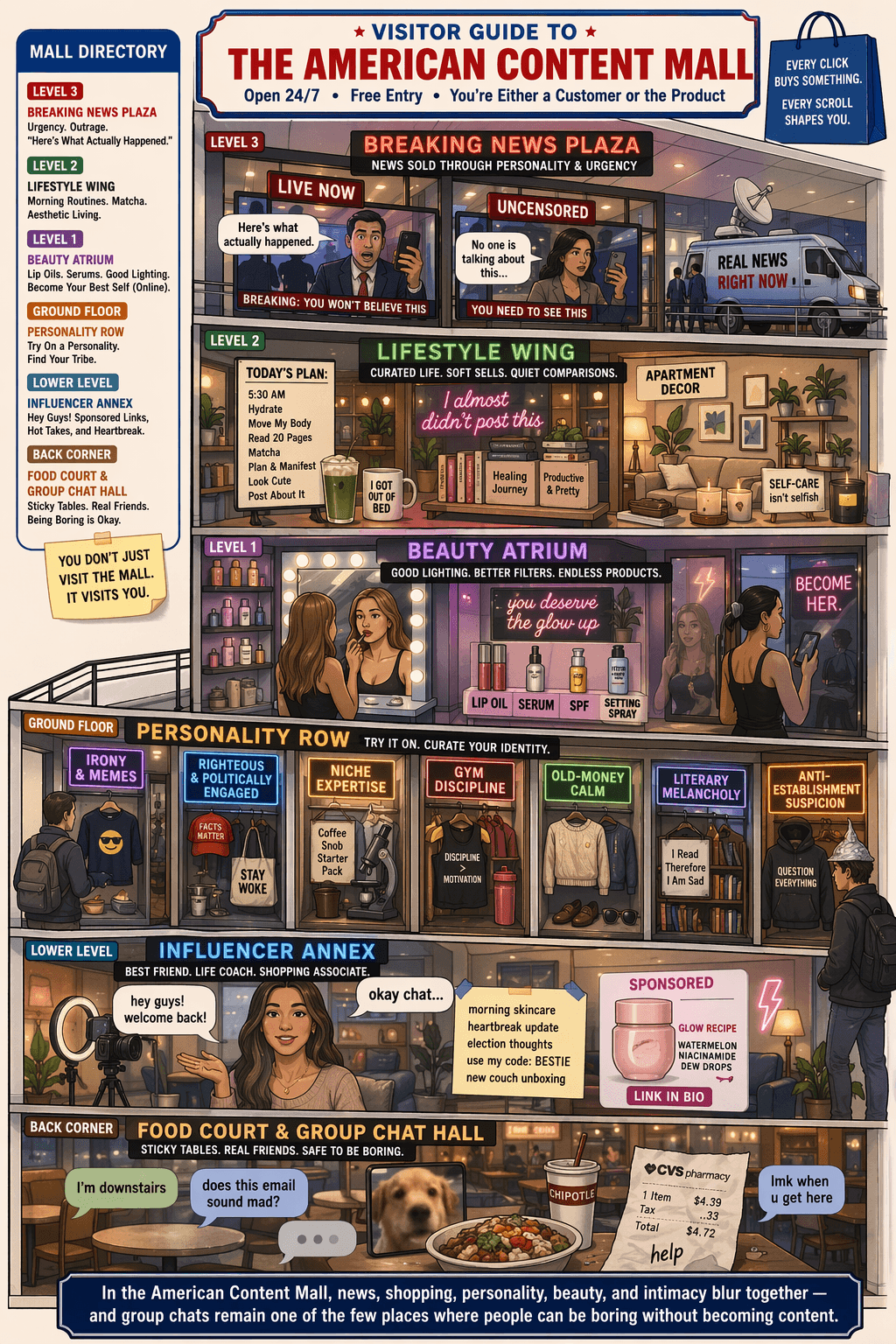
On the first floor is Breaking News Plaza, where the stores are narrow and brightly lit and every clerk appears to be speaking urgently from inside a car. They hold phones at windshield level and say things like you are not hearing the full story, or no one is talking about this, or here is what actually happened. Customers like this floor because it feels faster than old newspapers and friendlier than television. The clerks often speak in the tone of someone leaning across a kitchen table. What they sell is not merely information. It is information already softened by personality, as if events become easier to swallow when handed over by a person with clean eyebrows and a ring light.
Past that is the Lifestyle Wing, one of the oldest and most profitable sections of the mall. Here one may purchase an ideal morning, an ideal bookshelf, an ideal body lotion, an ideal apartment in Brooklyn with impossible natural light, an ideal seven-step reset routine, or an ideal emotional vocabulary. Several stores specialize in authenticity. Their signs are handwritten on purpose. Their floors are designed to look slightly unfinished. Their employees wear expensive versions of exhaustion. The bestselling items include candidness, vulnerability, and the phrase I almost did not post this.
Across from Lifestyle is the Beauty Atrium, which has no walls because it long ago overflowed its original lease. Here, girls test lip oils under white lights and boys learn the names of serums and both are instructed, gently, that there is still time to become the sort of person whose bathroom shelf deserves a close-up. Mirrors are everywhere. None are especially accurate. Some lengthen the face. Some flatten it. Some do something stranger, which is to show a person not as they are but as they might look after being looked at long enough.
The food options are abundant. In the center court one can choose between protein bowls, matcha, moral panic, celebrity divorce updates, apartment tours, football clips, war footage, and recipes with thirty-seven ingredients no one actually has at home. The scent system is advanced and adjusted by demographic. College students are led by coffee, discounts, and jokes about not answering emails. Young professionals are drawn by signs promising balance. Parents are ushered toward educational toys, pediatric anxiety, and articles explaining whether screen time has permanently altered the child. There is no map that fully captures the layout because the walls shift according to purchase history.
The most crowded level, however, is Personality Row.
This is where people go not to buy things but to choose a way of having a face in public. Some storefronts offer irony in bulk. Others sell righteousness, niche expertise, therapeutic fluency, old-money calm, gym discipline, literary melancholy, anti-establishment suspicion, or the kind of effortless cool that requires six hours of maintenance per week. The fitting rooms here are always full. A customer enters feeling ordinary and exits dressed as a person who has taken. A great many customers return items privately after midnight.
Below Personality Row is the Influencer Annex, where the mall’s rules become especially difficult to explain. It is not quite retail and not quite theater. Shoppers wander in believing they are there for guidance and leave unsure whether they have been advised, entertained, befriended, advertised to, politically activated, or all five in rapid succession. In this annex the salespeople know your first name, or speak as if they do. They begin with hey guys, or hi friends, or okay chat, and they move so fluidly between skin care, heartbreak, elections, digestive health, and sponsored links that the old distinction between commerce and confession begins to look quaint.
Children are often first taken to the mall by force, but adults return voluntarily. Some even claim to work there. You can tell the employees by their posture. They are never fully off shift. At brunch they evaluate natural light. On walks they notice whether a sentence would do well as a caption. At concerts they hold up not only phones but a second interior self, one that hovers above the evening asking whether this is content. Many of them are paid little or nothing. This arrangement does not seem to trouble management.
There are, to be fair, useful services available. The mall can help locate a lost recipe, a protest, a diagnosis, a sublet, a roommate, a tutorial on repairing a lamp, the live score of a game, three strangers who also hated a finale, or a woman in Ohio who has arranged Trader Joe’s freezer meals by emotional category. It can introduce a lonely person to prove that loneliness is not unique. It can, on a good day, make the country feel less vast. It has elevators between subcultures. It has windows into lives not your own.
It is simply difficult to remain a citizen there. The architecture strongly encourages becoming either a customer or a product.
For this reason, seasoned visitors speak in whispers about the least glamorous section of the mall: the Food Court Annex, sometimes called Group Chat Hall.
It is not much to look at. The tables are sticky. The lighting is poor. Nothing is branded correctly. One corner contains three roommates discussing whether an RA email sounds threatening. Another contains a family thread with ten unread messages and a blurry photo of somebody’s dog. A graduate student sends a picture of a CVS receipt and writes help. Someone else posts their Chipotle bowl with no explanation. Nobody asks them to improve it. Nobody requests context, framing, polish, or a better hook. The messages here are short, badly spelled, and structurally unsound. Many would be worthless outside the annex. Inside, they are evidence of a small miracle: continuity without performance.
Developers have repeatedly attempted to renovate this section. They propose enhanced search, automatic summaries, cross-platform integration, and emotional analytics. The regulars resist. They become harder to index. They use nicknames, fragments, references to incidents that occurred six months ago and were funny only once. Their language grows private and therefore durable. The annex remains one of the few spaces in the mall where a sentence like I’m downstairs or this email feels weird can still be understood as sufficient.
Visitors who spend too long in the brighter wings sometimes arrive at Group Chat Hall in a state of unusual fatigue. They sit down carrying half-assembled selves. They no longer wish to be informative, attractive, coherent, or seen by anyone beyond six to ten specific people. Here, for a brief period, they are allowed to be boring. This is a service the more luxurious floors cannot provide.
Mall brochures do not mention this.
Management prefers the public to believe that the highest form of participation is visibility. But some guests, after years of walking the escalators, come to suspect the opposite. They begin to think that whatever remains most human in them is not the polished storefront, nor the urgent monologue from the car, nor the sponsored tenderness, nor the face adjusted for good lighting, but the unsellable parts carried quietly to the sticky tables in the back.
If you visit the American Content Mall, you may enjoy yourself. Many people do. You may leave better dressed in language than when you arrived. You may discover a cause, a moisturizer, a recipe, a panic, a framework, a stranger who seems to understand your exact niche grievance. It would be dishonest to deny the mall its pleasures.
Just do not forget, while wandering its endless levels, that some of the most valuable rooms are the ones that look least like stores.
I used AI to generate the following image: